
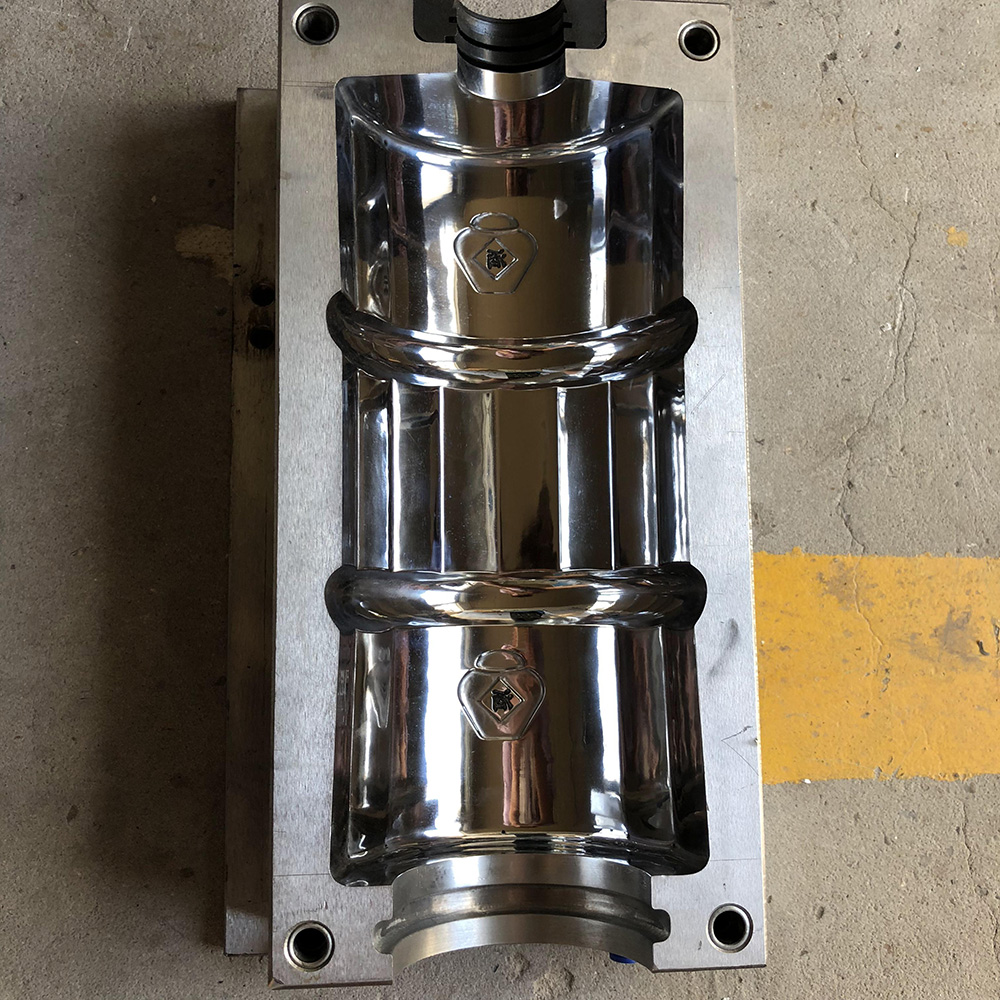
Overcoming Common Defects in Large-Volume PET Container Blowing:
A Technical Guide for Manufacturers
Introduction
Blowing large-volume PET containers (ranging from 3 Liters to 20 Liters / 5 Gallons) presents distinct thermodynamic and physical challenges compared to processing standard single-serve beverage bottles. Due to the thicker walls, deeper draw ratios, and massive shot weights of large preforms, the margin for error is razor-thin. Even minor discrepancies in preform design or mold venting can trigger critical defects, leading to high scrap rates and structural failure.
As a leading Chinese manufacturer specializing in high-performance blow molding machine molds and PET preform molds, Yushun Machine has spent decades analyzing polymer behavior in high-volume containers. This guide provides a deep-dive engineering analysis of common large-bottle blowing defects and details how professional mold design directly mitigates these production bottlenecks.
1. Pearlescence (Over-Stretching & Cold Blowing)
The Defect: Pearlescence, or "stress whitening," manifests as a cloudy, silver-white appearance on the container's surface. It occurs when PET molecules are stretched beyond their natural draw ratio limits or stretched at too low of a temperature, causing micro-voids and local structural delamination.
Root Causes & Solutions:
- Inadequate Preform Heat Profile: Thicker preforms for large-volume containers absorb infrared heat unevenly. The solution is using a blow molding machine with localized heating zone control and allowing sufficient equilibration time in the heating oven.
- Improper Stretch Ratio: If the initial preform dimensions are poorly matched to the final bottle size, the stretch ratio will be incorrect. Yushun Machine optimizes the preform-to-bottle geometry during the initial CAD/CAE phase, ensuring a highly accurate radial and axial stretch ratio.
2. Uneven Wall Thickness Distribution
The Defect: Extreme wall thickness variation causes weak spots that cave in during filling, palletizing, or transportation. In large-volume containers, gravity often pulls molten PET downward during the stretch phase, resulting in overly thick bottoms and dangerously thin shoulders.
Engineering Key: Concentricity is the deciding factor in wall thickness uniformity. If the preform mold gate is misaligned by even 0.1mm during injection, the resulting preform will have uneven wall thickness, causing severe blowing defects.
Technical Solutions:
- Concentricity and Core Alignment: Our PET preform molds feature patented self-lock and taper-lock alignment systems. This prevents core shifting during high-pressure injection, ensuring perfectly uniform preform walls.
- Optimized Blowing Mold Cavity Venting: Air trapped inside the mold cavity prevents the PET bubble from expanding evenly against the mold wall. We engineer microscopic, strategically placed air exhaust vents to allow rapid evacuation of air during high-pressure blowing (up to 40 bar).
3. Base Cracking and Poor Stress Distribution
The Defect: Large-volume containers (especially 5-gallon water dispenser bottles) must withstand immense vertical loads. Base cracking occurs when the crystalline structure of the base is compromised, or when the injection gate is not perfectly centered in the blow mold's base cup.
Technical Solutions:
- Conformal Base Cooling: The base of a large container is the thickest portion and takes the longest to cool. Yushun Machine designs advanced conformal water cooling channels inside the base mold insert. Rapid heat removal freezes the polymer chains, optimizing impact strength and preventing post-molding shrinkage.
- Precise Gate Centering: Our blow molds integrate a heavy-duty centering lock that aligns the blowing machine's stretch rod precisely with the base mold center, securing the gate in the dead-center of the base.
Defect Troubleshooting Matrix for Large-Volume PET Containers
| Observed Defect | Primary Root Cause | Mold-Side Solution (Yushun Machine) | Process-Side Adjustments |
|---|---|---|---|
| Pearlescence (Whitening) | Over-stretching / low material temperature | Redesign PET preform geometry for optimal stretch ratios | Increase infrared heating lamp intensity; delay pre-blow |
| Uneven Wall Thickness | Concentricity shift or improper pre-blow pressure | Utilize self-locking core/cavity PET preform molds | Adjust pre-blow pressure and start time |
| Bottom Cracking | Incomplete cooling / decentralized gate | Incorporate high-flow conformal base cooling channels | Increase cooling water flow rate; check stretch rod alignment |
| Hazy/Cloudy Bottle | Overheating (Crystallization) | Optimize alloy thermal conductivity in blowing mold | Lower heating oven temperatures; increase ventilation |
The Yushun Machine Difference: Precision Engineering from China
Producing large-volume PET containers requires more than standard equipment; it demands tailored engineering expertise. Yushun Machine offers holistic system support, seamlessly integrating PET preform molds and blow molding machine molds to run in complete harmony. By utilizing high-grade imported tooling steels (such as S136 and 718H) and state-of-the-art CNC machining centers, we guarantee exceptional mold durability, thermal efficiency, and minimal downtime.
Whether you are producing 5L edible oil bottles, 10L water carboys, or heavy-duty 20L returnable containers, our custom-engineered mold solutions will lower your defect rates, increase your production throughput, and deliver a fast, predictable ROI.