
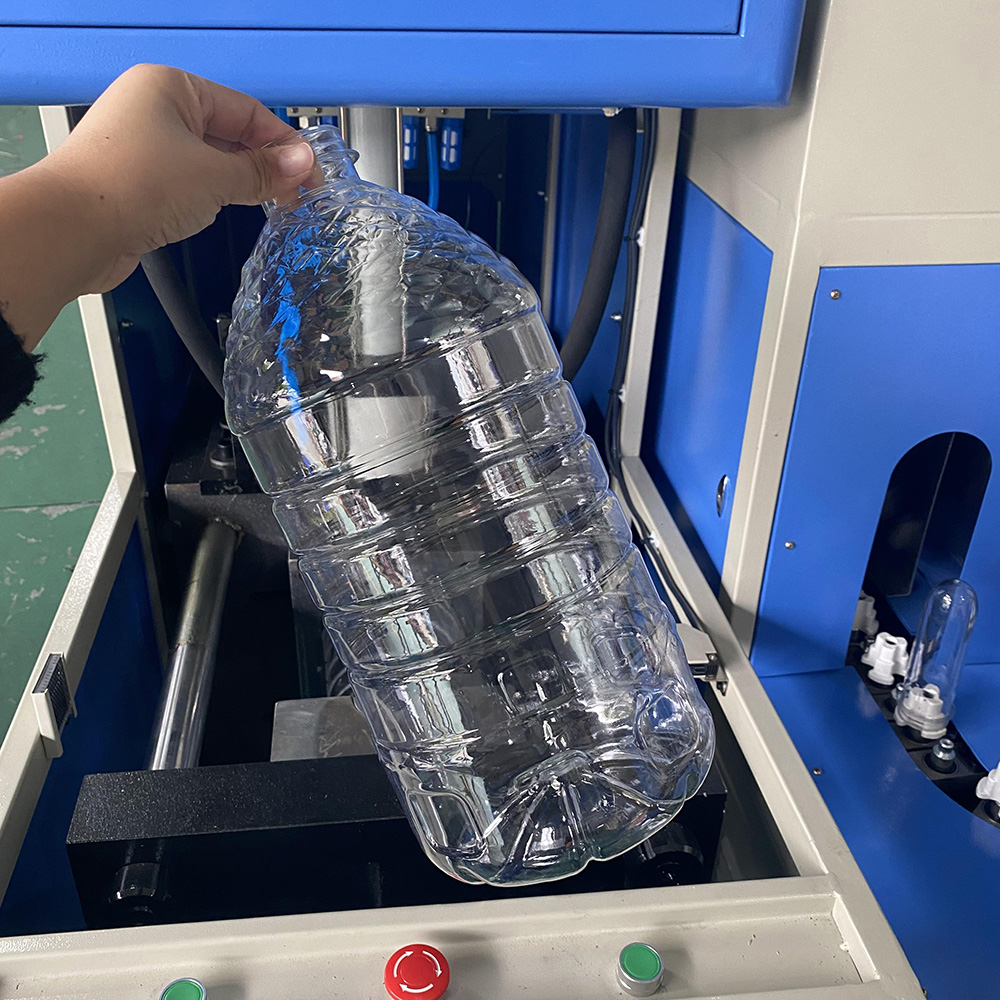
YUSHUN MACHINE manufactures PET blow molding machines and blow molds as an integrated product line, serving bottle producers in water, beverage, edible oil, and household chemical segments. This position gives us a specific perspective on supplier evaluation: the machine’s technical merits are inseparable from the tooling it must carry. A machine that performs beautifully with the manufacturer’s demo mold may fail with your production mold—and the reverse is equally true.
This guide examines the technical capabilities that separate reliable manufacturers from assemblers, organized around the questions that matter at the specification and acceptance stages.
Capability 1: Heating System Precision and Compensation Logic
The heating oven is where preform quality is either preserved or destroyed. PET preforms arrive at the blow molding machine with a thermal history from the injection molder. The machine’s heating system must bring each preform to the optimal stretch temperature uniformly—circumferentially and axially—within a narrow window.
Uneven heating produces uneven wall thickness in the blown bottle. As published technical literature on PET processing notes, uneven preform filling at the injection stage leads to different heat profiles across cavities, and “this always results in wall thickness differences of the blown bottles” [citation:4]. The blow molding machine cannot fix a poorly distributed preform, but a well-designed heating system can absorb normal preform variation without amplifying it.
What to Verify in the Heating System
- Zone independence and resolution: How many independently controlled heating zones exist along the preform’s length? A system with coarse zoning cannot compensate for preform wall thickness variation that the injection molder could not eliminate.
- Lamp-to-preform distance control: The heating profile is a function of radiant intensity and exposure time. Mechanical stability of the lamp carriage directly affects repeatability. Ask for the specified tolerance on lamp positioning and the maintenance procedure for lamp replacement.
- Preform temperature feedback: Some machines offer infrared temperature monitoring of the preform surface after heating [citation:3]. This is a diagnostic and control capability, not a marketing feature. Ask how the feedback is used: Does it alarm only, or does it adjust lamp power in real time?
- Cooling air distribution: Active cooling of the preform surface after heating prevents over-softening of the outer skin. Uneven airflow across the preform circumference produces asymmetric wall distribution in the final bottle. Request airflow verification data at the preform surface.
Capability 2: Mold Interface and Changeover Engineering
A blow molding machine is only as flexible as its mold interface. Bottle producers increasingly run multiple SKUs on the same line—a 500 ml water bottle in the morning, a 1.5 L CSD bottle in the afternoon. The machine’s mold clamping system, blow nozzle alignment, and base mold actuation must accommodate changeovers without requiring shims, re-alignment, or extended downtime.
The industry trend is toward tooling that reduces changeover friction. Competek’s recent Flex Mould development addresses this directly: “a tool-free mould replacement system” designed to “reduce set-up times and simplify the transfer of production between compatible machines” [citation:8]. While that specific product is a mold-side solution, the principle applies to machine evaluation: how does the machine’s interface design support or hinder rapid, repeatable mold changes?
What to Verify in the Mold Interface
| Interface Element | Technical Question | Why It Matters |
|---|---|---|
| Clamping mechanism | Is clamping force servo-controlled or pneumatic/hydraulic? What is the repeatability of clamp position? | Inconsistent clamping causes mold shift and uneven wall thickness; servo clamping provides position feedback |
| Blow nozzle alignment | How is the nozzle centered relative to the preform neck? Is there a mechanical stop or sensor-based positioning? | Misalignment causes neck distortion and blow failure; repeatability after changeover is critical |
| Base mold actuation | CAM-synchronized or servo-driven? What is the tolerance on base mold closing timing? | Base mold timing affects material distribution in the bottle base and foot formation |
| Mold mounting pattern | Does the machine accept standard mold footprints, or is tooling proprietary? | Proprietary interfaces limit future tooling sourcing and increase long-term cost |
A machine that requires shimming the mold or adjusting sensors after every changeover will consume production time and introduce variability. Ask the manufacturer to demonstrate a changeover with your mold or a comparable production mold, and measure the elapsed time from last bottle to first accepted bottle.
Capability 3: Acceptance Testing with Your Product
The most important technical capability is the manufacturer’s willingness to prove performance with your bottle, your preform, and your acceptance criteria. A machine that runs at 6,000 BPH with the manufacturer’s reference mold is not the same machine that will run at 6,000 BPH with your production mold and your resin.
Published supplier evaluation guidance is consistent on this point: “Output should be confirmed for your actual bottle and preform, not only for a supplier’s reference bottle” [citation:2]. The same principle applies to bottle quality: wall distribution, base clearance, and neck dimensional accuracy must be measured on bottles blown from your preforms, using your mold, at the quoted rate.
Acceptance Test Protocol: What to Require in Writing
- Defined test conditions: Resin grade, preform source and lot, mold identification, ambient conditions, and utility supply parameters (voltage, air pressure, cooling water temperature).
- Output measurement: Bottles per hour measured over a continuous run of at least four hours, with reject bottles counted and classified. “Nameplate output” is not an acceptance criterion.
- Quality measurement: Wall thickness at defined points (body, shoulder, base) for a statistically meaningful sample; base clearance and stability; neck dimensions per the preform/finish drawing.
- Energy consumption: Measured at the machine’s supply terminals during the acceptance run, expressed as kWh per 1,000 accepted bottles. This establishes the baseline for operating cost comparison.
- Changeover demonstration: If multiple SKUs are planned, demonstrate a complete changeover and first-article approval within the agreed time.
Capability 4: Documentation and Spare Parts Discipline
Reliability after installation is determined by documentation quality and parts strategy. A blow molding machine is a long-lived asset with wear components: blow nozzles, stretch rods, valve seals, lamp elements, and gripper pads. The manufacturer’s approach to documenting these components and making them identifiable determines how quickly your maintenance team can respond to a stoppage.
Supplier evaluation frameworks emphasize this: “Ask for a parts list that connects the machine’s wear and service items to usable identifiers” [citation:6]. A photograph of a worn part is not a parts number. A generic spare kit does not cover a revised valve package or a non-standard mold height.
Documentation Checklist
- As-built configuration sheet: Model, serial number, and all optional equipment actually installed—not the brochure configuration.
- Pneumatic and electrical schematics: Current revision, with component identifiers that match the physical machine.
- PLC program backup and recipe structure: Documented access procedure for authorized maintenance personnel.
- Wear parts list with lead times: For the first year of operation, identify which parts should be stocked at the plant and which can be ordered on demand.
- Preventive maintenance schedule: Based on the machine’s actual duty cycle, not a generic interval.
Capability 5: Integrated Mold and Machine Engineering
The boundary between “machine problem” and “mold problem” is often the most expensive diagnostic gap in a bottle plant. When a bottle has a base defect, is the cause the base mold profile, the stretch rod timing, the blow pressure, or the preform base thickness? If the machine manufacturer and the mold manufacturer are separate companies with no integrated engineering responsibility, the plant absorbs the cost of that ambiguity.
YUSHUN MACHINE’s position is that the blow mold and the blow molding machine should be engineered as a system. The machine’s stretch rod profile must match the mold’s base geometry. The blow nozzle must be compatible with the preform’s neck finish. The heating profile must be validated against the preform’s wall distribution. When these elements are specified together, the acceptance test measures a known system, not an untested combination.
For buyers evaluating separate machine and mold suppliers, the practical recommendation is to require a joint interface specification: a document signed by both suppliers that defines the mechanical, pneumatic, and electrical interfaces between the mold and the machine, and assigns responsibility for performance at that boundary.
Frequently Asked Questions
What is the most important specification when comparing PET blow molding machines?
Guaranteed output with your bottle and your mold, verified under defined conditions, is more valuable than any single machine specification. A machine rated at 6,000 BPH with a reference mold may produce 4,500 BPH with your production mold if the heating profile and mold interface are not optimized. Require the manufacturer to state output for your specific application, not a generic maximum.
How can I evaluate a manufacturer’s heating system without visiting the factory?
Request the heating system documentation: number of zones, lamp type and power, lamp-to-preform distance tolerance, and the procedure for verifying temperature uniformity across the preform circumference. Ask for a sample of bottles blown on the proposed machine model from preforms comparable to yours, and measure wall thickness distribution independently. A manufacturer confident in the heating system will provide this data without resistance.
Does YUSHUN MACHINE provide blow molds and machines as a matched system?
Yes. YUSHUN MACHINE manufactures both PET blow molding machines and blow molds, and we specify the machine configuration based on the mold and bottle design—not the reverse. For customers with existing molds, we evaluate mold compatibility before quoting a machine, and we document any interface modifications required.
What after-sales documentation should be required in the purchase contract?
At minimum: as-built configuration sheet, electrical and pneumatic schematics at current revision, PLC backup, wear parts list with lead times, and a preventive maintenance schedule based on your duty cycle. Installation and training scope should be defined in writing, including the number of training days, the topics covered, and whether training occurs before or after first production.