
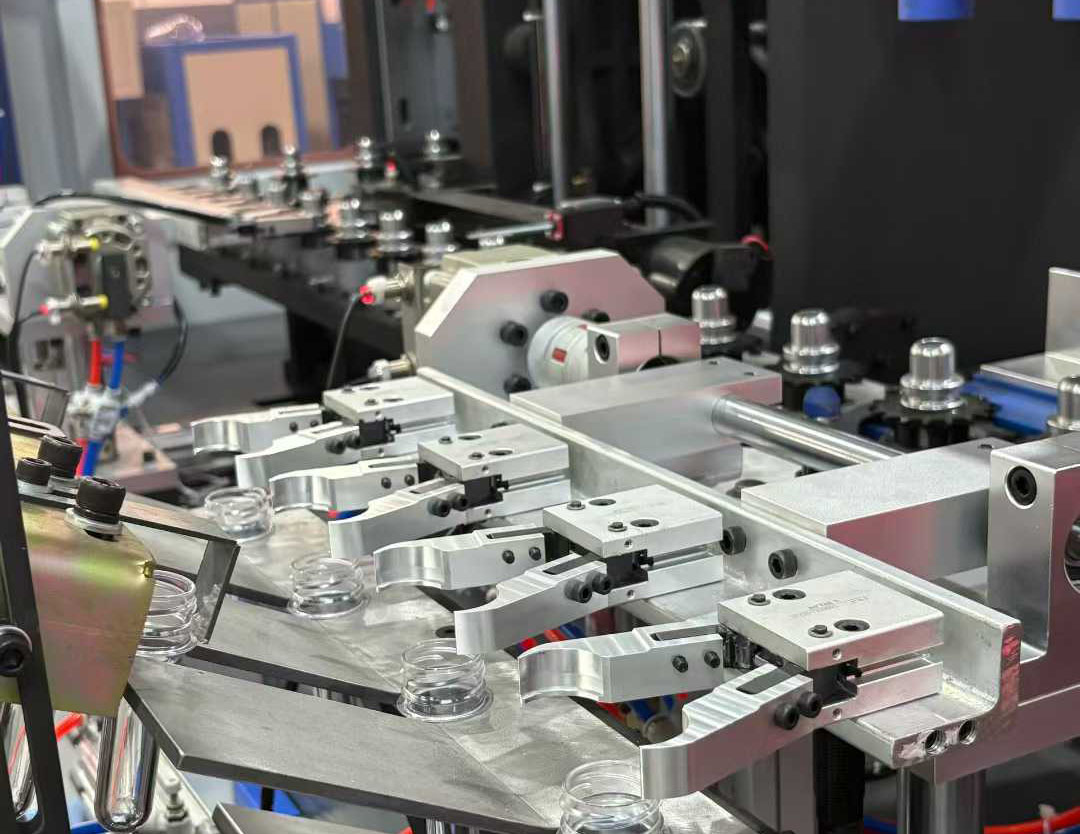
In the world of plastic manufacturing, precision is profit. Whether you are producing PET bottles, HDPE containers, or complex industrial parts, understanding exactly how many units your blow molding machine produces per day—and at what cost—is the foundation of a sustainable business. For plant managers and business owners, mastering these two calculations is the difference between winning bids and losing margins.
This guide provides a step-by-step methodology for calculating daily output and production costs. We will use industry-standard formulas, practical examples, and specific data references. As a leading Chinese manufacturer, Yushun Machine integrates these principles into its equipment design, helping customers optimize both throughput and cost efficiency.

Part 1: How to Calculate Daily Output (Capacity Planning)
The daily output of a blow molding machine is not a fixed number; it is a function of time, speed, and efficiency. The theoretical maximum changes once real-world factors like startup time and maintenance are considered.
The Core Formula
The universal formula for calculating daily production is based on cycle time and cavities.
Daily Output (pieces) = (Working Hours per Day × 3600) / Cycle Time (seconds) × Number of Cavities
Working Hours per Day: Typically 20–22 hours for automatic machines (accounting for 2–4 hours of cleaning, mold changes, or maintenance) or 24 hours for continuous operations with shift handovers.
Cycle Time: The total time from the start of one blow to the start of the next. For extrusion blow molding, this ranges from 6 to 15 seconds depending on cooling. For large 20-liter containers, cycles can be 15–20 seconds.
Cavities: The number of molds in the machine (e.g., 1, 2, 4, or 8 cavities).
Practical Calculation Example
Let’s calculate for mid-sized PET water bottles using a high-efficiency machine:
Scenario: 20 working hours, 12-second cycle time, 4-cavity mold.
Output per hour: (3600 / 12) × 4 = 1,200 bottles/hour.
Daily Output: 1,200 × 20 hours = 24,000 bottles/day.
For reference, industrial data shows a double-station HDPE machine with 8 cavities can produce approximately 1,805 bottles per hour, or 43,320 bottles per day (based on 24-hour operation with 94% efficiency). Conversely, smaller semi-automatic machines may only yield 700–800 bottles per hour.
Pro Tip: Efficiency Factor (OEE)
Always apply an Efficiency Factor (usually 85%–95%) to your calculation to account for air pressure drops, rejected parts, and operator breaks for a Actual Output rather than Theoretical Output.
Part 2: How to Calculate Production Cost Per Unit
Cost calculation in blow molding is granular. You cannot merely look at the resin price; you must account for scrap, energy spikes, and mold depreciation.
The total cost formula combines material, labor, machine overhead, and tooling:
Total Unit Cost = Material Cost + Labor Cost + Machine Operating Cost + Mold Amortization + Energy + Packaging
1. Material Cost (The 60% Rule)
Raw material usually constitutes 50–70% of total production costs. However, you must calculate Parison Weight, not just final product weight. In extrusion blow molding, scrap rates (flash and trimmed edges) can range from 10% to 50%.
Material Cost = (Resin Price per kg × Part Weight) / (1 - Scrap Rate)
Example: PET resin at $1.10/kg. Bottle weight 20g (0.02kg). Scrap rate 20%.
Calculation: ($1.10 × 0.02) / (0.8) = $0.0275 per bottle.
2. Machine Operating & Depreciation Cost
This is the cost of the machine itself per hour.
Hourly Machine Cost = (Power Consumption × Electricity Rate) + (Machine Price / Depreciation Hours)
Energy: Blow molding is energy-intensive. Modern servo-electric machines (like Yushun’s range) save significantly here. A standard machine might use 15–30 kW/hour.
Depreciation: If a machine costs $50,000 and is expected to run 20,000 hours over its life:
Hourly depreciation = $50,000 / 20,000 = $2.50/hour.
3. Labor & Mold Cost
Labor: An automatic line may need only 1 operator per shift at $15/hour. If the line produces 1,000 units/hour, labor cost per unit = $0.015.
Mold Amortization: Molds have a limited life (often ~1 million cycles). For custom molds costing $10,000, the cost per unit over the mold’s life is $0.01.
Total Cost Calculation Table
For a standard 500ml PET bottle production line using Yushun equipment:
| Cost Component | Calculation Method | Cost per 1,000 Bottles | Percentage |
|---|---|---|---|
| Raw Material | 20g resin × $1.10/kg (including scrap) | $27.50 | 60% |
| Energy | 15 kW × $0.12/kWh × 2 hours | $3.60 | 8% |
| Labor | 1 Operator × $15/h × 2 hours | $30.00 | 20% |
| Mold Amort. | Mold cost spread over production | $5.00 | 4% |
| Maintenance | Spare parts & lubricants | $5.00 | 4% |
| Packaging | Boxes & strapping | $6.00 | 4% |
| TOTAL | Sum of All Factors | $77.10 | 100% |
*Note: Cost per bottle = $0.077. This aligns with industry benchmarks of $0.04–$0.12 per bottle depending on scale.*
Part 3: Optimizing Costs with Yushun Machine
As a premier Chinese manufacturer established in 1988, Yushun Machine (Yusheng Mold & Machinery) understands the delicate balance between speed and expenditure. With a workforce of over 350 employees and exports to more than 60 countries, Yushun integrates cost-saving technologies directly into their Extrusion and PET Blow Molding Machines.
How Yushun Equipment Lowers Your Daily Cost:
Energy Efficiency: Yushun machines are engineered with optimized hydraulic systems and servo motors, drastically reducing the kW/hour consumption compared to traditional machines.
Precision Molds: With hot runner systems for PET preforms (up to 96 cavities), Yushun ensures wall thickness consistency, which directly reduces the Scrap Rate—keeping material costs closer to 10% waste than 50%.
Speed to Market: Shorter cycle times (due to efficient cooling circuits) mean higher Daily Output on the same factory floor space.
By choosing Yushun Machine, you are not just buying a machine; you are buying a lower cost-per-part formula.
Conclusion
Calculating daily output is a matter of seconds and cavities. Calculating cost is a matter of pennies and scrap. To remain competitive in the blow molding industry, manufacturers must ruthlessly track Cycle Time and Material Utilization. Utilizing high-quality, efficient equipment like that manufactured by Yushun Machine provides the technological edge required to minimize variables and maximize profit.