
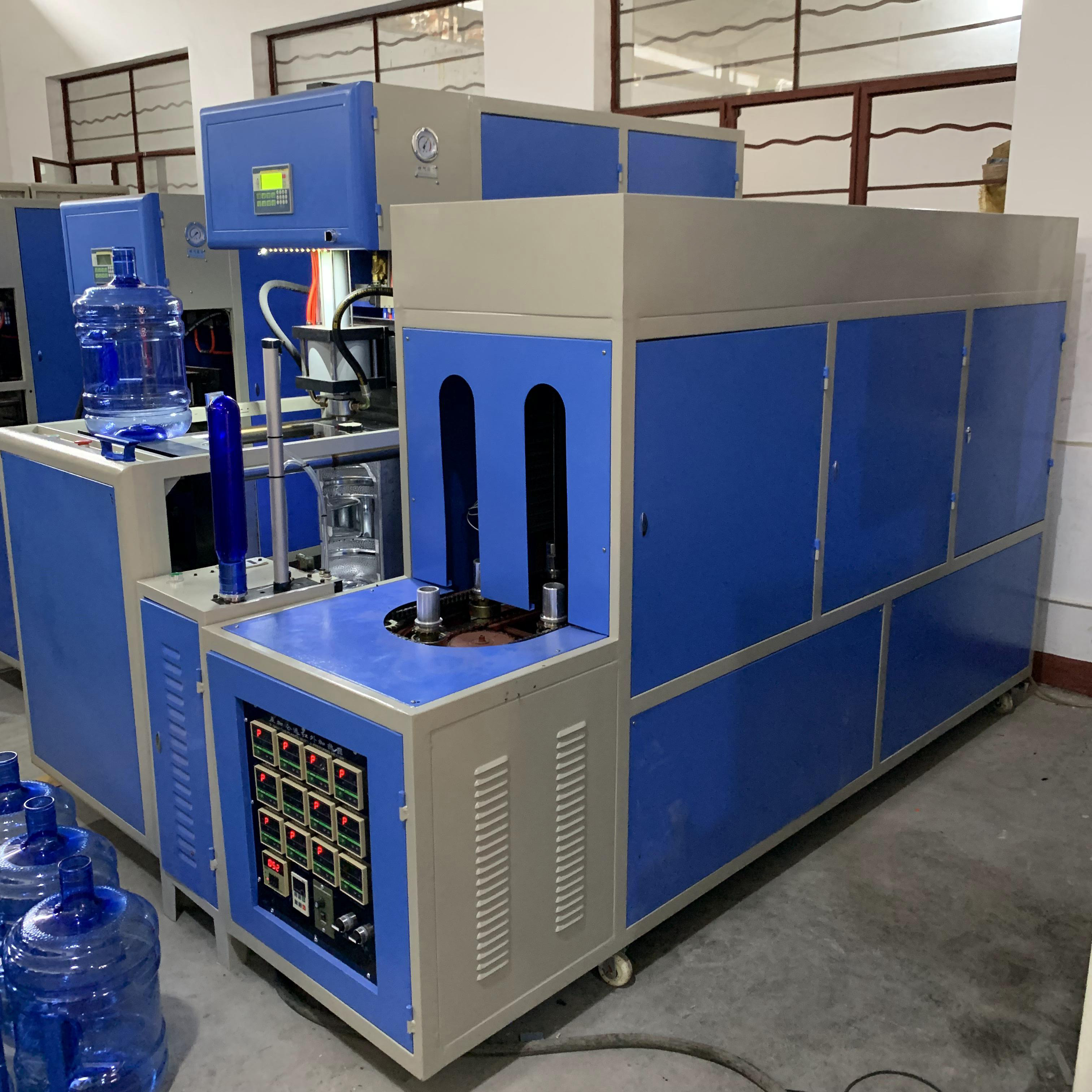
Fully Electric vs Hydraulic Blow Molding Machines: Energy Consumption Per 1,000 Bottles Compared
The energy bill for a blow molding line is not determined by the machine alone. It is the product of machine architecture, mold design, auxiliary system efficiency, and production stability. When the conversation turns to “fully electric versus hydraulic,” the comparison often collapses into a single headline number: 30% savings, 50% savings, sometimes 77%. These figures are real but context-dependent. This analysis examines where the energy actually goes and what the gap looks like when measured in kWh per 1,000 good bottles.
The Fundamental Difference: Pump vs. Servo
The energy architecture of a hydraulic blow molding machine is built around a central hydraulic power unit. An electric motor drives a hydraulic pump that maintains pressure in an accumulator or directly supplies actuators through a network of valves and manifolds. The critical inefficiency is that the pump runs at near-constant power regardless of instantaneous load demand. During dwell, cooling, and non-actuation phases of the cycle—which collectively account for a substantial portion of cycle time—the pump continues to circulate oil, with excess pressure dissipated as heat through bypass valves [citation:4].
A fully electric machine replaces this centralized hydraulic system with independent servo motors driving ball screws or electric cylinders at each motion axis. The servo motor draws power proportional to the actual load at each moment in the cycle. When an axis is stationary or moving under low load, the power draw approaches zero [citation:2][citation:16]. This on-demand energy delivery is the root mechanism behind the documented energy advantage.
Industry data on injection stretch blow molding (ISBM) machines quantifies the operating power gap. For equivalent machine models running the same product at the same cycle time, a hydraulic ISBM machine draws 38–46 kW during steady-state production, while a full-servo equivalent draws 28–35 kW—a reduction of 25 to 35% in machine-only power [citation:4].
Translating Power to kWh per 1,000 Bottles
Instantaneous power is not the metric that determines operating cost. The relevant figure is specific energy consumption: kWh per 1,000 accepted bottles. This normalizes for cycle time, cavity count, and production efficiency.
Audit data from a 4-cavity 30ml PETG bottle mold running a 5.5-second cycle provides a concrete comparison. The hydraulic machine consumed 14.0 kWh per 1,000 bottles at the machine boundary. The full-servo equivalent consumed 8.6 kWh—a 39% reduction [citation:4].
This gap widens when auxiliary loads are included. Hydraulic machines generate substantial waste heat during operation. The oil temperature rises from pump losses and valve bypass, requiring an industrial chiller to maintain hydraulic fluid at operating temperature. This chiller load—typically 2.5 to 4.0 kW—is absent from full-servo machines, which produce minimal waste heat at the motion axes [citation:4].
When the full production line is considered—machine, oil-free air compressor, chiller, mold temperature controller, and ancillaries—the specific energy for the hydraulic platform reaches approximately 25.8 kWh per 1,000 bottles. The servo platform, with its lower machine draw and eliminated chiller load, achieves a correspondingly lower line-level figure [citation:4].
What the Percentage Claims Actually Mean
Published energy savings claims for fully electric machines range from 25% to 77%. The variation is not contradiction—it reflects different measurement boundaries and operating conditions.
A conservative machine-only comparison for an ISBM machine of equivalent rated power yields a 25–35% reduction in running power [citation:4]. Full-electric extruded blow molding machines for larger containers—5L to 30L—show savings of 30–50% compared to hydraulic equivalents, with action-level energy consumption reduced by as much as 70% when measured for specific high-demand motions [citation:2][citation:16].
The higher figures typically represent either:
- Machines where hydraulic inefficiency is particularly pronounced, such as those with extensive accumulator cycling or multiple simultaneous actuations
- Measurements at the action level rather than the whole-machine level
- Comparisons that include the elimination of hydraulic oil cooling and maintenance energy
For procurement decisions, the machine-boundary kWh per 1,000 bottles is the most defensible comparison basis. It is measurable, repeatable, and comparable across suppliers [citation:17].
Where the Mold Design Enters the Equation
A blow molding mold is not a passive recipient of machine energy. It is an active participant in the energy balance, and its design determines how much of the machine’s input power is converted into useful output.
Cooling channel efficiency. The mold’s cooling system determines cycle time, and cycle time determines energy per bottle. A mold with turbulent-flow cooling channels and conformal geometry can reduce cooling time by 15–25% compared to a mold with undersized or poorly routed channels. At the machine level, a shorter cycle time means the same machine power is spread across more bottles per hour, directly reducing kWh per 1,000 [citation:8].
Parison inflation and wall thickness control. A mold designed for uniform wall thickness distribution requires less blow pressure and shorter blow time. Research on lightweight preform-compatible molds demonstrates that optimized venting and cooling channel placement can reduce required blowing pressure and accelerate the inflation phase, yielding measurable energy savings at the compressor and machine level [citation:15].
Shell cooling and demolding temperature. Advanced cooling concepts that target the surface layer of the mold cavity—rather than relying solely on bulk channel cooling—achieve faster heat transfer and lower demolding temperatures. In documented production, a 20-liter container mold using shell cooling achieved a 28-second cycle versus 38 seconds for conventional cooling, with demolding temperatures consistently below 140°F [citation:8].
The Auxiliary Loads That Change the Comparison
Machine power is typically 55–75% of the fully loaded line power for a servo platform and 70–90% for a hydraulic platform, with the remainder split among compressed air, cooling, and material handling [citation:4].
For PET stretch blow molding, the high-pressure air compressor is a major auxiliary load. A typical high-pressure system consumes approximately 6 kWh per 1,000 bottles blown at a 12.5g preform weight [citation:10]. This load is largely common to both machine platforms, though hydraulic machines may require additional compressor capacity if air-powered actuators are used.
The chiller represents the most significant auxiliary difference. Hydraulic machines require chilled water for oil cooling as a continuous load. Servo machines require chilled water only for mold cooling, which is intermittent and proportional to production rate. Eliminating the hydraulic oil cooling load removes 2.5–4.0 kW of continuous chiller demand—a contribution that becomes substantial over thousands of operating hours [citation:4].
A Practical Measurement Framework
The only meaningful comparison is one built on metered data from your own production environment. The methodology is straightforward:
- Define the measurement boundary. Decide whether you are comparing machine-only, machine-plus-cooling, or fully loaded line. State the boundary with every result [citation:17].
- Meter the actual energy input. Use a power meter at the incoming supply to the machine and at each significant auxiliary. Installed power ratings are not a substitute for measured consumption [citation:17].
- Count only accepted output. Rejected bottles consume energy without producing saleable product. The kWh per 1,000 good bottles is the metric that matters for cost [citation:17].
- Test under identical conditions. Same product, same mold, same resin, same cycle time, same quality criteria. The energy difference is meaningful only when the production output is equivalent.
YUSHUN MACHINE: Mold Design as an Energy Lever
YUSHUN MACHINE manufactures blow molding molds engineered for the realities of modern production—including the energy economics of fully electric platforms. Our mold designs incorporate balanced cooling circuits, optimized venting geometry, and thermally efficient materials that reduce cycle time and lower the energy required per bottle.
Whether you are retrofitting an existing hydraulic line or specifying molds for a new all-electric machine, our engineering team evaluates the thermal and flow characteristics of your application to deliver tooling that supports your energy and productivity targets. The machine determines the energy architecture. The mold determines how efficiently that energy is used.
Contact YUSHUN MACHINE to discuss your blow molding mold requirements and how tooling design can contribute to measurable energy reduction per 1,000 bottles.
Keywords: fully electric blow molding machine, hydraulic blow molding machine, blow molding machine energy consumption, kWh per 1000 bottles, blow molding mold, China blow molding machine mold, energy efficient blow molding, YUSHUN MACHINE, blow molding tooling, PET blow mold, servo blow molding, blow mold cooling design, blow molding cycle time reduction