
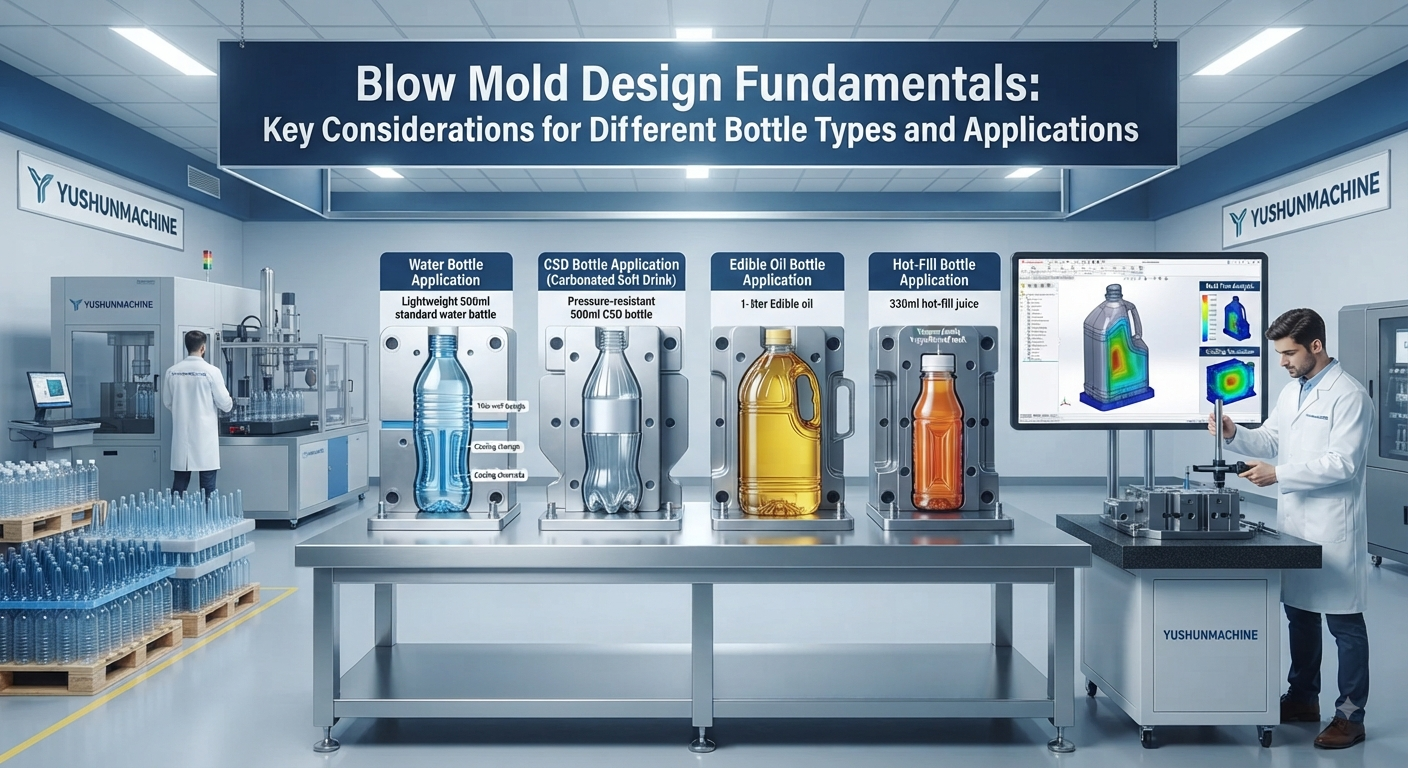
1. Fundamental Principles of Engineering Blow Molds
Regardless of the specific container application, every high-speed stretch blow mold relies on three core structural pillars:
- Metallurgical Selection and Durability: Depending on cycle speed and clamping pressures (reaching up to 40 bar), cavities are machined from forged aircraft-grade aluminum alloy or premium imported tool steels such as S136 or 718H. Hardened steel parting lines prevent wear and micro-flashing over long production runs.
- Thermodynamic Circuit Architecture: In-mold cooling speed directly sets the total cycle time. Advanced blow molds incorporate high-velocity conformal cooling pathways placed close to high-mass zones—such as the neck shoulder and base cup—to freeze the stretched polymer matrix rapidly.
- Micro-Venting and Exhaust Dynamics: Trapped air between the expanding preform and the mold cavity walls causes surface defects and incomplete geometry formation. Micro-vents precision-machined along parting lines, ribs, and base profiles allow compressed air to exhaust instantaneously during expansion.
2. Application-Specific Mold Design Engineering
A. Mineral Water & Still Beverage Containers (Lightweighting Focus)
For still water, the main design goal is resin minimization without sacrificing top-load resistance for pallet stacking. The mold cavity must feature strategically placed ribbing structures and ergonomic waist grips that add structural stiffness to thin container walls.
B. Carbonated Soft Drinks (CSD) (Internal Pressure Focus)
CSD bottles experience continuous internal pressures of up to 4 to 5 bar from dissolved carbon dioxide. Standard flat-bottom molds will deform under this pressure.
Engineering Requirement: CSD molds require a specialized petaloid base cup design featuring 5 rounded feet. The mold base must be engineered with reinforced steel inserts to handle internal pressure and prevent stress cracking.
C. Hot-Fill Juices & Teas (Thermal Shrinkage Focus)
Hot-fill beverages are capped at temperatures between 85°C and 92°C. As the liquid cools, it creates an internal vacuum that pulls container walls inward. Hot-fill blow molds incorporate vacuum absorption panels along the body sidewalls and feature heat-setting fluid channels operating with hot oil circulating at 120°C to 140°C to induce thermal strain crystallization.
D. Wide-Mouth Jars & Edible Oil Containers (Geometric & Viscosity Focus)
Wide-mouth containers and heavy edible oil bottles require custom radial stretch calculations. Molds must feature specialized split-cavity mechanics and optimized draft angles to ensure clean, automatic ejection of large-diameter shapes without drag marks.
3. Synchronizing Blow Molds with PET Preform Molds
A blow mold cannot correct structural defects caused by an incorrectly designed preform. Achieving optimal wall thickness, optical clarity, and structural strength requires synchronizing the preform geometry with the final blow mold cavity.
Yushun Machine addresses this challenge by engineering paired combinations of PET preform molds and bottle blowing machine molds. Utilizing advanced 3D FEA simulations and wall-thickness calculations, our engineering team ensures the preform's axial and hoop stretch ratios align perfectly with the target bottle geometry, reducing material scrap rates to under 0.15%.
Blow Mold Design Parameter Matrix
The comparative matrix below outlines key engineering variables across primary bottle application categories:
| Application Category | Cavity Alloy / Steel Grade | Base Cup Geometry | Cooling Circuit Target | Key Engineering Challenge |
|---|---|---|---|---|
| Still Water | Aircraft Aluminum / Steel S136 | Shallow standing rim, light ribs | Chilled water (6°C - 8°C) | Maximizing top-load strength on thin walls |
| Carbonated Soft Drinks | Forged Tool Steel (718H / S136) | 5-Petaloid high-pressure base | High-velocity base cooling | Resisting internal pressure creep & stress cracking |
| Hot-Fill Liquids | High-Hardness Stainless Steel | Rigid structural base cup | Circulating hot oil heat-set circuits | Thermal shrinkage & vacuum panel collapse |
| Edible Oil / Jars | Corrosion-Resistant Steel / Aluminum | Deep-set heavy bottom cup | Multi-zone body cooling | Ensuring smooth ejection on wide-mouth geometries |
Yushun Machine: Your Trusted Global Tooling Partner
Designing high-performance blow molds requires deep technical expertise in thermodynamics, material science, and high-speed machine kinematics. Yushun Machine offers turnkey engineering solutions from China, producing custom-engineered combinations of PET preform molds and blow molding machine molds built for automatic, high-throughput manufacturing environments.
By pairing high-precision CNC machining with advanced 3D mold-flow simulations and rigorous factory testing, Yushun Machine ensures your facility achieves stable production runs, fast cycle times, and minimal operating costs.
Upgrade your packaging line with custom-engineered tooling. Contact Yushun Machine today to review your bottle design specifications and optimize your manufacturing capabilities.