
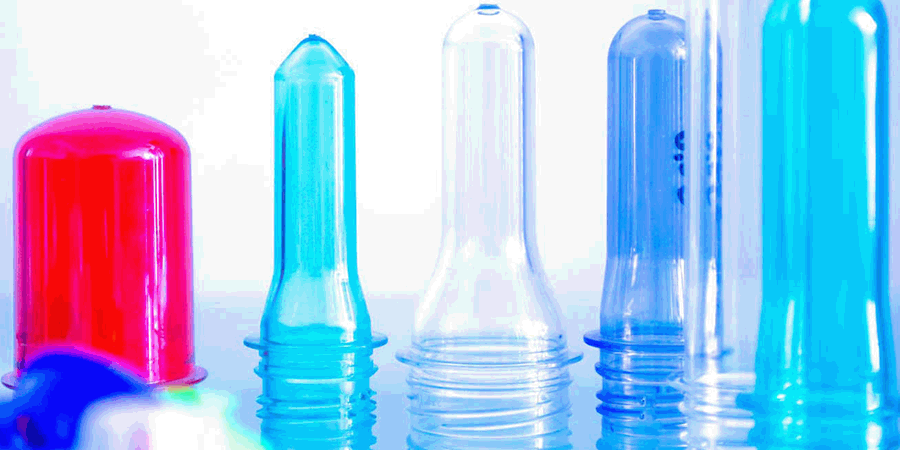
Discovering that your mold is not compatible with your blow molding machine can be a frustrating and costly situation. Whether you have purchased a new mold that does not fit, inherited equipment with mismatched components, or are trying to use an existing mold on a different machine, there are several practical solutions available. This guide from YUSHUN outlines the common causes of mold incompatibility and provides actionable steps to resolve the issue.
Common Causes of Mold Incompatibility
Understanding why your mold does not fit is the first step toward finding a solution.
| Cause | Description |
|---|---|
| Incorrect mold dimensions | Mold thickness, height, or width does not match machine specifications |
| Mismatched neck finish | Preform neck finish incompatible with machine handling system |
| Improper alignment features | Guide pins, locating rings, or clamping surfaces do not align |
| Different manufacturer standards | Mold designed for one machine brand may not fit another |
| Worn or damaged components | Existing mold components may have worn beyond specification |
| Missing adapter plates | Required adapter plates for mounting were not supplied |
Step 1: Identify the Specific Incompatibility
Before taking action, you need to determine exactly why the mold does not fit.
Check Mold Dimensions
Verify the following dimensions against your machine's specifications:
Mold thickness (when closed)
Mold height
Mold width
Guide pin positions and diameters
Locating ring dimensions
Alignment groove positions
If the dimensions are close but not exact, modification may be possible. If they are completely different, you may need different solutions.
Inspect the Neck Finish Area
The neck finish of the preform must be compatible with the machine's neck handling system. Common issues include:
Neck ring dimensions do not match machine grippers
Thread profile incompatible with machine transfer system
Support ledge thickness incorrect
Examine Wear and Damage
Sometimes the issue is not with the mold design but with its condition. Check for:
Damaged alignment surfaces
Bent or broken guide pins
Step 2: Consider Mold Modification
For many compatibility issues, professional mold modification is a cost-effective solution.
Professional Mold Repair and Modification Services
Specialized mold service companies can modify existing molds to fit different machines. Services typically include :
Dimensional modification – Adjusting mold thickness, height, or mounting features
Guide pin replacement – Installing new guide pins in different positions
Locating ring modification – Changing locating ring size or position
Neck finish adaptation – Modifying neck ring area for different handling systems
One advantage of working with specialized mold service providers is that they can often perform modifications even without original drawings by taking measurements from the actual mold components and manufacturing replacement parts as needed .
What Modification Can Address
What Modification May Not Address
Fundamentally different neck finish standards
Completely incompatible mold handling systems
Significant size differences (e.g., mold designed for much larger machine)
Step 3: Use Adapter Plates or Mounting Hardware
For some compatibility issues, adapter plates can bridge the gap between mold and machine.
Mold Adapters
An adapter plate mounts between the machine platen and the mold, converting mounting patterns, adjusting thickness, or providing proper alignment features. This is often the simplest solution for minor dimensional differences.
Custom Adapter Design
If standard adapters are not available, a machine shop can fabricate custom adapter plates. Provide them with:
Machine mounting interface specifications (hole pattern, size, locating features)
Mold mounting interface specifications
Required thickness and clearance requirements
Adapter Limitations
Adapters add thickness, which may reduce machine opening capacity. They also add cost and complexity to mold changes. For permanent installations, direct mold modification may be preferable.
Step 4: Consult the Mold Manufacturer
If you know who manufactured the mold, contacting them directly is often the best approach.
Questions to Ask Your Mold Manufacturer
Can this mold be modified for compatibility with your specific machine model?
What is the cost and lead time for modification?
Can you supply adapter plates or mounting hardware?
Is there a trade-in program toward a compatible mold?
Even if the original manufacturer is no longer in business, many specialized mold service companies can work from the actual mold components to perform necessary modifications .
Step 5: Consider Machine Modification
In some cases, modifying the blow molding machine may be more practical than modifying the mold. This is particularly true if you have multiple molds for the same machine standard.
Possible Machine Modifications
Platen modification – Adding or changing mounting holes
Neck handling system adjustment – Adapting to different neck finish standards
Clamping system modification – Adjusting opening stroke or clamping force
Considerations
Machine modifications are generally more invasive and expensive than mold modifications. They also affect all molds used on that machine. This approach is best when you have a significant investment in molds for a particular standard.
Step 6: Sell or Trade the Incompatible Mold
If modification is not practical, consider recovering value from the incompatible mold.
Options
Sell the mold to a company with compatible equipment
Trade the mold with another manufacturer
Trade in with mold manufacturer toward a compatible mold
Scrap the mold for raw material value (last resort)
Where to Find Buyers
Industry forums and marketplaces
Used equipment dealers
Industry trade associations
Direct outreach to other bottle manufacturers
Step 7: Purchase a Compatible Mold
If other options are exhausted, purchasing a new mold designed specifically for your machine may be the best solution.
Information Needed for New Mold
To ensure compatibility with a new mold, provide your mold supplier with:
Machine make and model
Platen mounting dimensions – hole pattern, thread sizes
Mold thickness range – minimum and maximum your machine accepts
Guide pin specifications – size, position, orientation
Locating ring specifications – size and position
Neck finish standard – PCO, 1881, ALCO, or custom
Bottle specifications – volume, shape, dimensions
YUSHUN can supply custom molds designed specifically for your blow molding machine, ensuring perfect compatibility from the start.
Prevention: Avoiding Future Compatibility Issues
When Purchasing a New Mold
Before ordering a new mold, provide your mold supplier with complete machine specifications. Request a drawing of the mold mounting interface for approval before manufacturing begins.
When Purchasing a Used Machine
If buying a used blow molding machine, request sample molds or mounting specifications to verify compatibility with your existing molds. Consider having the machine inspected by a qualified technician.
When Purchasing Used Molds
Before buying used molds, verify:
Original machine type they were designed for
Current condition (wear, damage, modifications)
Whether mounting drawings or specifications are available
Summary Decision Guide
YUSHUN Can Help
As a professional manufacturer of blow molding machines, YUSHUN can assist with mold compatibility issues in several ways:
Supply compatible molds – Custom manufactured to your machine specifications
Provide machine specifications – Detailed mounting information for mold suppliers
Technical consultation – Guidance on resolving compatibility issues
Adapter plate design – Assistance with interface solutions
Contact YUSHUN today for expert assistance with your mold compatibility challenges.