
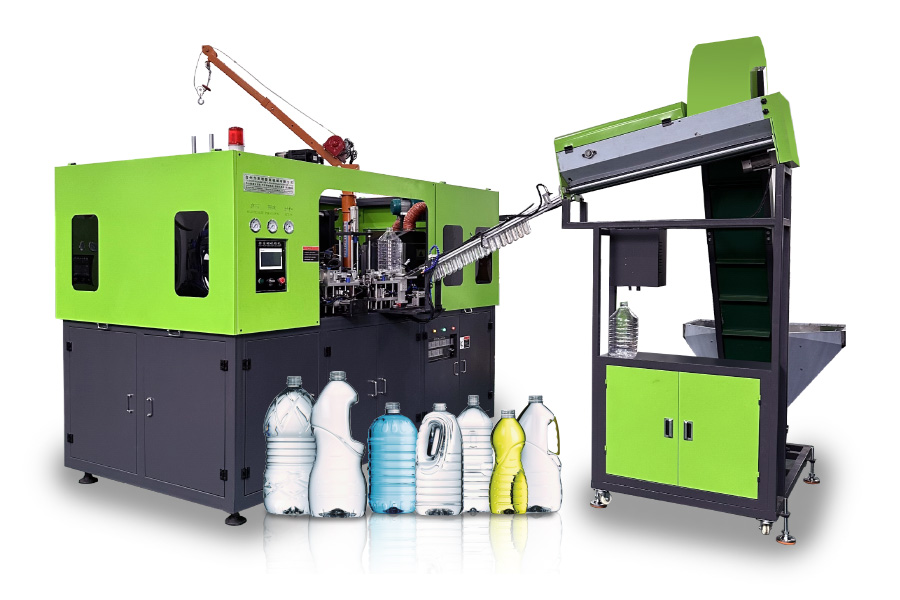
Have you ever wondered how the perfectly shaped, lightweight, and durable plastic bottles for your water, soda, or juice are made? The answer lies in a marvel of modern engineering: the fully automatic PET blow molding machine. PET (Polyethylene Terephthalate) is the preferred material for packaging due to its clarity, strength, and recyclability. Understanding the PET blow molding process is key to appreciating the efficiency and precision behind global packaging supply chains.
This article provides a comprehensive overview of the operational principles of a fully automatic PET blow molding machine.
The Core Principle: Injection Stretch Blow Molding (ISBM)
Most modern automatic bottle making machines operate on the Injection Stretch Blow Molding (ISBM) principle. This is a two-stage process that ensures high production speed, excellent bottle clarity, and superior material distribution. The entire process is fully integrated and automated, from raw material to finished bottle, without human intervention.
Stage 1: Preform Injection Molding
The journey of a PET bottle begins not as a bottle, but as a test-tube-like object called a preform.
Drying and Feeding: Raw PET resin in the form of small pellets is first dried in a hopper to remove any moisture. Moisture can cause defects during processing, so this step is critical for quality.
Melting and Injection: The dried pellets are fed into an injection molding unit on the machine. Here, they are heated to a precise temperature (around 250-285°C) until they become a molten, viscous liquid.
Forming the Preform: This molten PET is then injected under high pressure into a multi-cavity mold. This mold shapes the plastic into the preforms. Each preform has a finished neck (complete with threads and cap specifications) and a thick, tubular body.
Cooling and Ejection: The preforms are cooled rapidly inside the mold to set their shape. They are then ejected and, in a fully integrated system, are transported via a conveyor to the blow molding station. In some setups, preforms are made separately and reheated later (this is called the two-stage method).
Stage 2: Reheating and Stretch Blow Molding
This is the stage where the preform is transformed into its final bottle shape.
Infrared Reheating: The cool preforms are passed through an infrared oven. This reheats them to a specific, uniform temperature (around 90-110°C) that is ideal for stretching and blowing. The temperature profile is carefully controlled to ensure even material distribution in the final bottle.
Transfer to Blow Mold: The heated preforms are automatically transferred and positioned inside the two-part, hollow blow molds. These molds define the final shape and external design of the bottle.
Stretching and Blowing: This is the critical two-step action:
Stretching: A stretch rod rapidly descends into the preform, mechanically stretching it lengthwise to the bottom of the mold.
Blowing: Simultaneously, high-pressure air (typically 20-40 bar) is injected into the preform. This forces the soft PET material outward to expand radially, taking the exact shape of the cold blow mold.
The combination of stretching and blowing (biaxial orientation) aligns the PET polymer chains, dramatically increasing the bottle's tensile strength, impact resistance, clarity, and gas barrier properties.
Cooling and Ejection: The newly formed bottle is held inside the mold for a few seconds to cool and solidify. The mold then opens, and the finished bottle is ejected onto a conveyor belt, ready for quality checks, filling, and capping.
Key Advantages of a Fully Automatic PET Blow Molding Machine
High Efficiency and Output: Capable of producing thousands of bottles per hour with minimal downtime.
Consistent Quality: Automation ensures every bottle is identical in weight, wall thickness, and dimensions.
Energy Efficient: Modern machines are designed to optimize heating and cooling cycles, reducing energy consumption.
Hygienic Production: The closed, automated process minimizes human contact, making it ideal for food and beverage packaging machinery.
Material Savings: Precise control over the blow molding process results in lightweight bottles that use the minimum amount of PET resin without compromising strength.
Conclusion
The fully automatic PET blow molding machine is a cornerstone of the modern packaging industry. By mastering the injection stretch blow molding (ISBM) process, these machines efficiently transform raw PET pellets into the high-quality, durable, and recyclable bottles we use every day. Its automated, high-speed, and precise operation makes it an indispensable asset for beverage bottle manufacturing and countless other sectors, ensuring a reliable and scalable supply of packaging solutions worldwide.